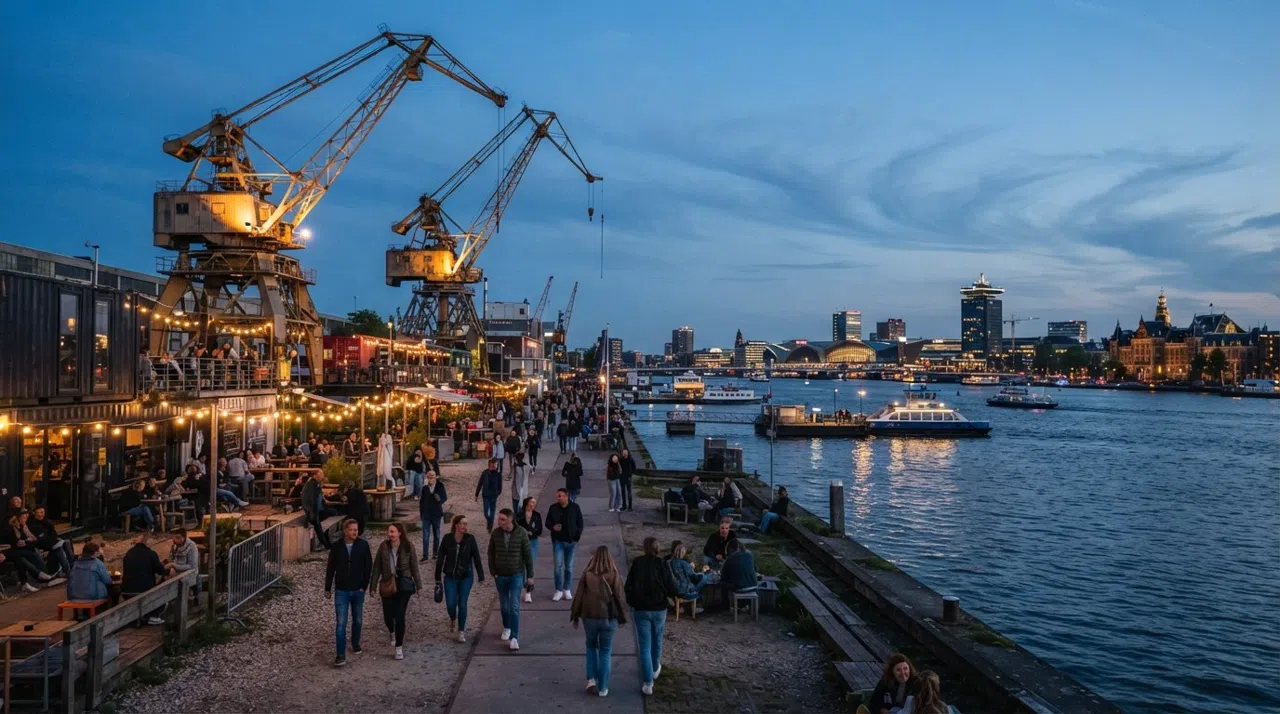
Cross the IJ on the free ferry behind Centraal and Amsterdam changes character in five minutes flat. One minute you’re in postcard mode; the next you’re staring at a decommissioned submarine by a quay, a container terrace, and a skyline that looks like it was assembled by people who own black hoodies and power tools. Noord has never bothered to pretend otherwise. It was heavy industry first, shipbuilding yard second, creative playground third — and that sequence still shows in the rust, the raw concrete, the murals and the cranes.
What Amsterdam-Noord is known for
Noord’s great trick is reinvention without sanding off the rough bits. The old NDSM wharf was where ocean liners were built until the 1980s; now the slipways, warehouses and hulking sheds are the stage set for studios, festivals and the sort of improvised city life that makes the centre look over-managed. You can still read the old working yard in the scale of the place. It’s not cute, and thank goodness for that.
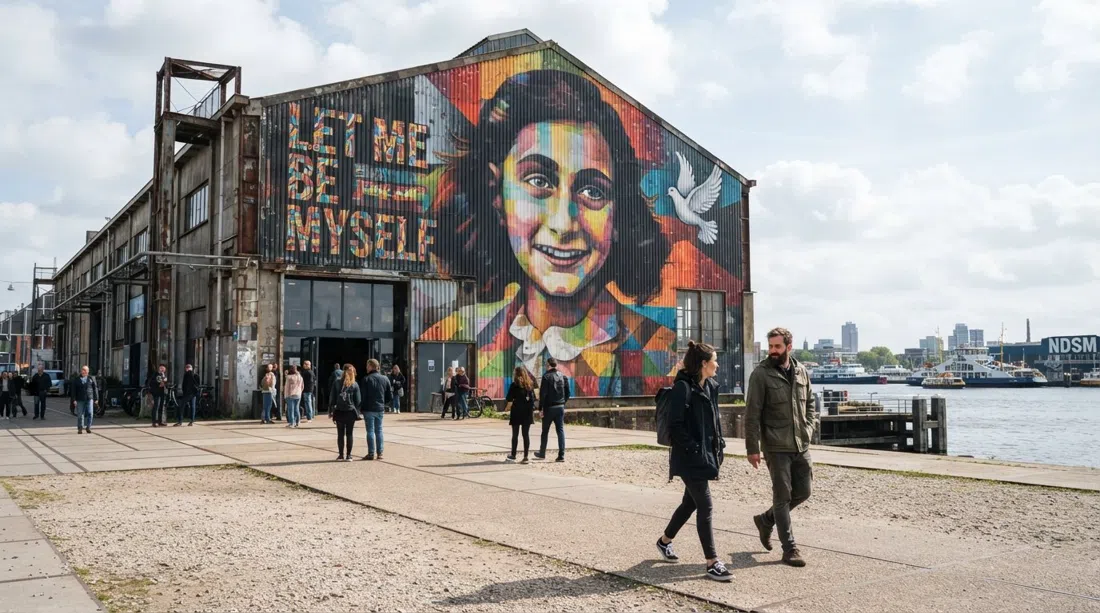
The headline act is STRAAT Museum, the world’s largest museum devoted to street art and graffiti, set inside an 8,000 m² former shipyard hall. The building itself feels like part of the collection, and then you step inside and realise the walls are only the beginning: more than 180 large-scale works by 170-plus artists, all with the kind of energy that makes you stand a little too close to the paint. Outside, Brazilian artist Eduardo Kobra’s enormous Anne Frank mural turns the façade into a landmark rather than a backdrop.
Across the wharf, Kunststad — Art City, if you want the translation — is a warren of around 200 artist and maker studios tucked into a cathedral-like industrial shed. It’s the sort of place where you can imagine someone welding a sculpture, screen-printing a poster and complaining about rent all in the same afternoon. Not glamorous, exactly. Better than glamorous.
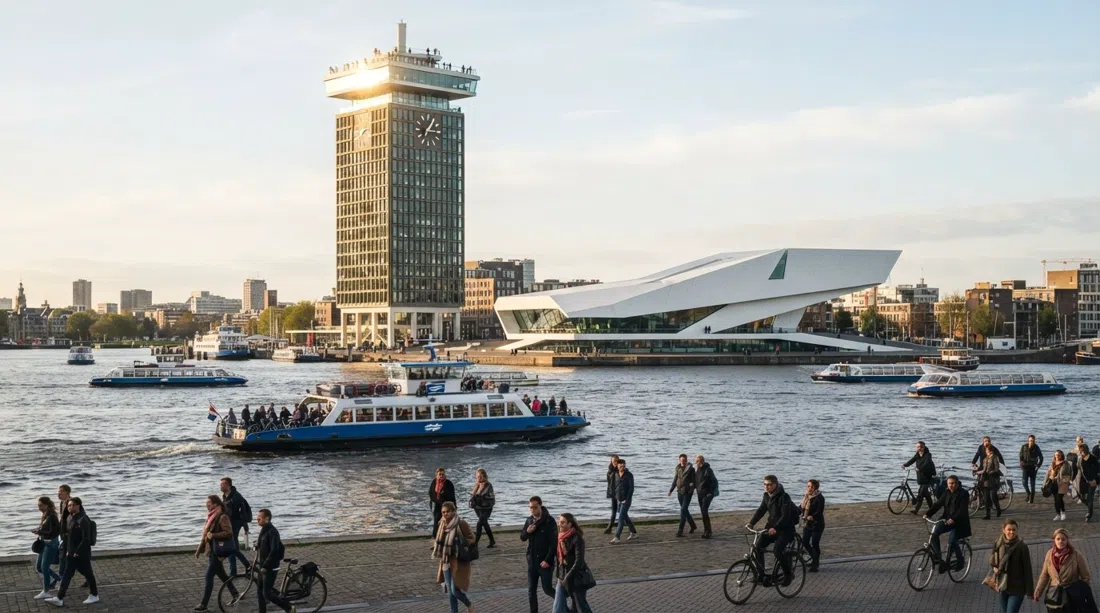
Then there’s the A'DAM Tower, which has become Noord’s most obvious landmark and its most obvious dare. It began life as a Shell office block; now it houses a hotel, restaurants and the A'DAM Lookout, where the rooftop deck comes with Over the Edge, billed as Europe’s highest swing. It dangles you roughly 100 metres above the IJ, which is either your idea of fun or a very expensive reminder to trust the harness. Beside it, the silvery EYE Filmmuseum sits like a shard of folded paper on the waterfront, right across from Centraal, and gives the whole Buiksloterweg side a proper civic anchor.
Noord also has a market habit that can turn a normal weekend into a minor expedition. IJ-Hallen, held roughly monthly on the NDSM grounds, is Europe’s largest flea market: around 750 stalls, entry about €6, and the sort of place where one person’s discarded lamp becomes your entire dining-room fantasy. Add a dense electronic-music scene and a ferry that runs all night, and you start to see why people cross the river specifically to come here.
Where to eat & drink
Eating in Noord is less about linen napkins than about weatherproof terraces, container walls and the pleasure of not paying centre-city prices for a decent plate of food. The district does water views with a kind of practical swagger. You sit outdoors because the room is open to the quay, or because the terrace is the room, and somehow that feels more honest than anything in the canal ring.
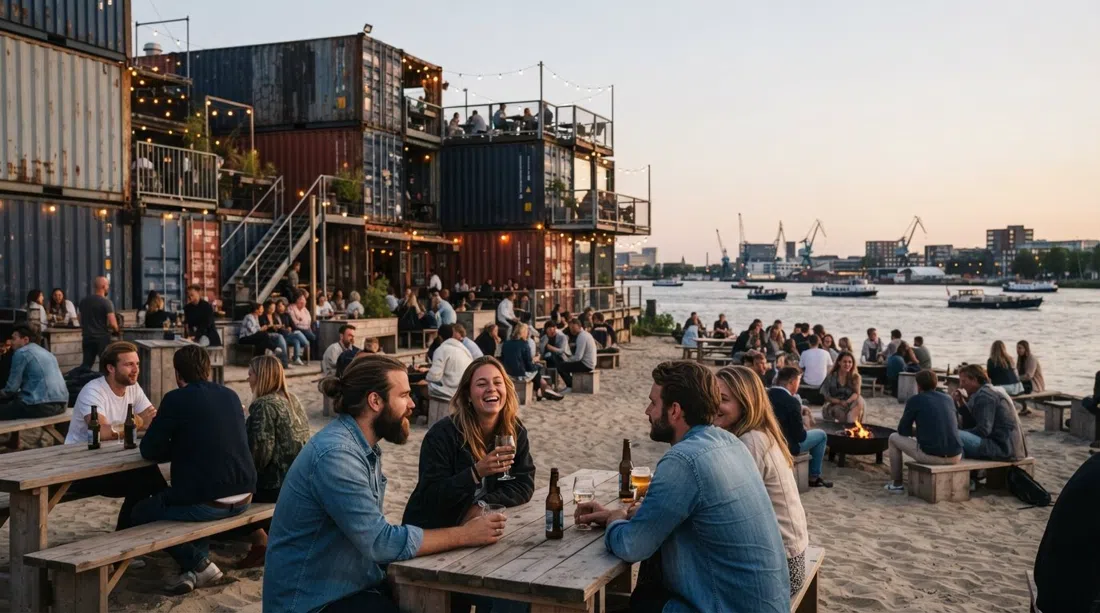
The emblem is Pllek, on the NDSM wharf: a bar-restaurant built from old shipping containers, with a man-made beach on the IJ and a menu that leans vegetarian and globally inflected. It’s the kind of place that can host a summer film night, yoga and a sunset drink without changing its clothes. That flexibility is very Noord: daytime to after-hours with almost no costume change.
A short walk east in the Hamerkwartier, Café-Restaurant Stork at Gedempt Hamerkanaal 201 is the city’s biggest seafood restaurant, and it behaves like it knows it. The room is cavernous, industrial and unapologetically large, but the reason to come is the terrace and the seafood: fruits de mer, whole seasonal fish, shellfish, all with the river as the backdrop. It’s one of those places that makes you forgive the size of the group next to you because the setting is doing enough work for everyone.
If you want something with a greener conscience and a more makeshift soul, Café de Ceuvel at Korte Papaverweg 4 in Buiksloterham is built from upcycled houseboats on a cleaned-up former shipyard. It runs largely off-grid and serves a 100% plant-based menu with drinks from independent brewers. That combination — old industrial ground, new ecological purpose — is exactly the kind of Noord story that doesn’t need a slogan.
On the wharf, Noorderlicht occupies a reclaimed greenhouse with a grassy waterfront terrace and veg-leaning food. By day it’s all sunlight and easy lunch energy; by the weekend there’s live music, and later the place takes on the more unruly glow of a room that knows how to keep going.
For beer, Oedipus Craft Space at Schaafstraat 21 in the Hamerkwartier is the taproom to know, pouring playful tripels and saisons Thursday to Sunday. It’s not trying to be refined; it’s trying to be good company. That’s a more Dutch ambition anyway.
Going out
Noord is where Amsterdam’s after-dark energy has drifted when the centre got too tidy for it. The old shipyard halls and warehouses give clubs the scale they need, and the district hosts a big share of the city’s electronic-music calendar, from DGTL on the NDSM grounds in spring to a heavy Amsterdam Dance Event presence in October. You feel that in the air before you even get to the door: bass leaking into the street, bikes leaned against railings, someone in a coat they clearly found secondhand and love more than they should.
For a regular night out, Skatecafe at Gedempt Hamerkanaal 42 is a Noord institution. It’s a bar-restaurant with a working mini skate ramp that becomes the dance floor when the DJs take over on Friday and Saturday nights, running until 03:00. That’s a very Amsterdam sentence and a very Noord one: food by evening, party by midnight, skaters still somehow in the room.
Then there’s Sexyland World on the IJplein side, a genuinely unusual cultural club owned by 365 members, each of whom programmes one day a year. That alone tells you more than any branding could. One night it might be queer parties, another experimental performance, another Caribbean-fusion food. It’s less a club than a civic experiment with a sound system.
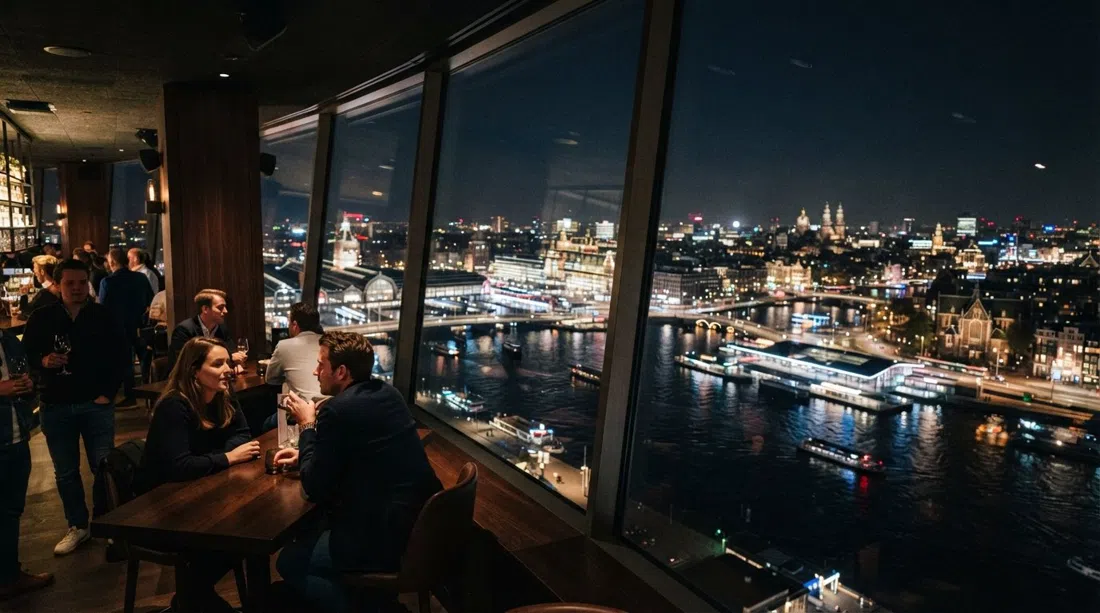
Out on the wharf, Noorderlicht shifts after dark from greenhouse-café to open-air club, with firepits and Afro, funk and global-beats sets. It has the easy, communal feel of a place where the evening spills rather than starts. And if you want your drink with a little altitude, Madam on the 20th floor of the A'DAM Tower turns from part of the daytime Lookout experience into a high-rise bar and party space once the sun goes down. The view does half the work, but the room knows that and doesn’t overcompensate.
Things to do / what to see
Start with the ride itself. The free GVB ferries from behind Centraal are part of the experience, not just the transport. They take bikes at no charge and run around the clock, which is one of those perfectly Dutch facts that feels almost too generous to be true until you’re standing on deck with the wind in your face. The F3 to Buiksloterweg is the quick hop, a few minutes over to the EYE, Tolhuistuin and the A'DAM Tower. The F4 to NDSM is longer, roughly 13–15 minutes, and that extra crossing time gives the whole wharf arrival a bit of theatre.
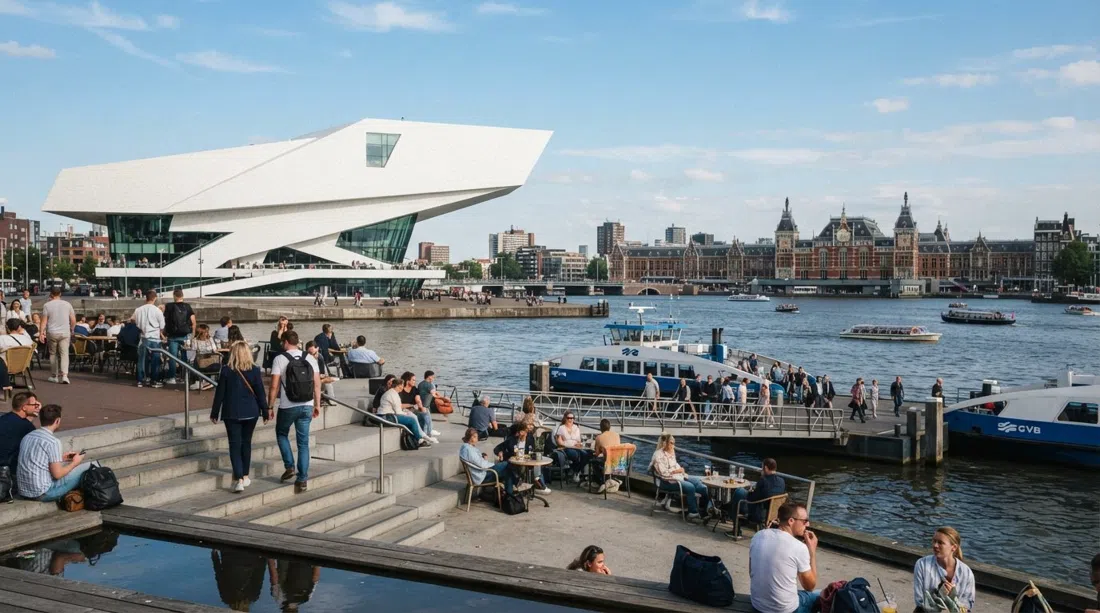
On the Buiksloterweg side you land beside the EYE Filmmuseum, whose swooping white building holds four cinemas, a permanent film exhibition and a stepped waterfront café-restaurant looking straight back at the city. It’s one of Noord’s most photogenic structures, yes, but more importantly it gives the district an intellectual centre of gravity. Cinema with a view is a very decent Amsterdam habit.
A minute away, Tolhuistuin is a cultural garden and music venue in a former Shell canteen. It’s a good place for a concert, or just a terrace drink before the evening gets louder elsewhere. The old corporate shell has been repurposed into something softer, which is one of Noord’s recurring pleasures: the same structures, different values.
Up the tower next door, A'DAM Lookout gives you a 360-degree deck and the Over the Edge swing. You do not need to swing if your nerves are already paying rent, but the deck alone offers the full geography of the city: water, ferries, roofs, cranes, and the sense that Amsterdam is larger and more layered than the centre likes to admit.
For contemporary art that feels more like being inside a system than looking at one, NXT Museum stages large-scale immersive digital and new-media installations in a former production studio. It belongs on the same circuit as STRAAT, but with a very different pulse: less wall, more environment.
The blockbuster on the calendar is IJ-Hallen, held roughly monthly on the NDSM grounds. With around 750 stalls indoors and out, it’s the largest flea market in Europe, entry about €6, open 09:00–16:30 on its weekends. If you like rummaging, this is your pilgrimage site. If you don’t, it’s still worth seeing for the sheer democratic chaos of it all.
Beyond the wharf, the leafy Noorderpark and the historic wooden houses of the Nieuwendammerdijk dyke village show a quieter, older Noord. This is the part people forget exists because the industrial edge gets all the attention. But ten minutes in the wrong direction can buy you allotments, quiet canals and a version of the district that feels almost village-like. Noord is huge; the wharf is only the billboard.
Shopping & markets
Noord is not where you come for polished retail. That job belongs to the centre, and Noord knows it. What it does have — and what it does better than almost anywhere else in the city — is market day. The star is IJ-Hallen, the monthly flea market on the NDSM wharf and the biggest in Europe. Roughly 750 stalls spill through two vast former shipyard halls and across the yard outside, selling secondhand clothing, vintage furniture, records, bikes, ceramics and the sort of general junk-treasure that turns into a very personal haul if you have enough patience and a tote bag.
Serious rummagers buy the early-entry ticket and arrive at opening. That’s not a lifestyle choice so much as a survival tactic. By the time the later crowds arrive, the good wool coats and decent Danish chairs have already been claimed by people who know exactly what they’re looking for.
Around the market, the wharf’s creative economy throws off smaller opportunities: vintage-clothing sellers, maker studios in Kunststad that open for events, and pop-up markets tied to festivals and to sustainable projects like Café de Ceuvel, which runs green markets and swap days. For everyday shopping, the neighbourhood high streets — Van der Pekstraat near the ferry among them — cover groceries and the odd independent. But the honest reason to shop in Noord is not chain retail or polished storefronts. It’s the possibility of leaving with a lamp, a record and a story you didn’t plan to tell.
Where to stay in Amsterdam-Noord
Staying in Noord is a trade-off I’d happily make if I wanted more room, lower rates and a neighbourhood that feels like it has an actual pulse after dark. You give up doorstep canals and accept that the city’s famous sights are a ferry ride away. In return, you get space, a bit of grit, and the pleasure of waking up somewhere that doesn’t look like it was designed for postcards.
The flagship is Sir Adam, the design hotel occupying the lower floors of the A'DAM Tower on the Buiksloterweg side. It’s a three-minute ferry from Centraal, with rooftop views built in, and it’s the obvious choice if you want central-quality style at a slightly-off-centre address. ClinkNOORD, a big designer hostel in a converted 1920s Shell laboratory near the Buiksloterweg ferry, suits younger and solo travellers with dorms, private rooms and a lively bar. And at the budget end, the Botel is a former river cruiser moored at NDSM, with plain, cabin-sized rooms and some of the lowest non-hostel rates in the city, plus a 24-hour ferry link.
For a splurge with a story, the Faralda Crane Hotel puts three luxury suites inside a preserved industrial crane on the NDSM quay, 30-plus metres up with a rooftop hot tub. That’s not just a room with a view; that’s a room with an origin story.
Pick your pocket by ferry line: the Buiksloterweg/A'DAM cluster is closest and best-connected, while NDSM is more atmospheric but a longer crossing.
Getting around
The free GVB ferries are the backbone of Noord. They leave from the docks directly behind Amsterdam Centraal, cost nothing, carry bikes for free and run 24 hours. The F3 to Buiksloterweg is the most frequent and the most useful for a short visit, a few-minute hop that lands you beside EYE, Tolhuistuin and the A'DAM Tower. The F4 to NDSM takes roughly 13–15 minutes and runs about every 15–20 minutes, dropping you at the wharf for STRAAT, Pllek and IJ-Hallen. The F2 to IJplein serves the Sexyland side.
The Noord–Zuid metro line (52) also crosses under the IJ, with Noorderpark station putting you in the greener part of the district in minutes from Centraal. Within Noord, a bike is the best tool you can bring: the terrain is flat, the traffic lighter than in the centre, and the wharf clusters are walkable once you land. Just remember that Noord is bigger than the headline strip around the ferry, so “nearby” can still mean a proper walk.
Reckon on about five minutes’ ferry plus a short walk from Centraal to the A'DAM/EYE side, and 15–20 minutes door-to-door to NDSM. For Schiphol, take the ferry or metro back to Centraal and the direct train, which takes roughly 15–20 minutes.